
ARTICLES: Deciphering Genuine Humans Hearts and Arts the Guruji Shrii Arnav 9:12 Way
These articles/ posts were first made on the Facebook profile of Guruji Shrii Arnav. Posts that tell a story and were well received are being featured in these sections. You can read the original post by clicking here.

 The Missing “PART” in “ART” that brings “Hearts” that are “Poles Apart” “Right from the Start” Of Art, Artists, Emotions, Gems and Life.
Deciphering Genuine Humans hearts and Arts the Guruji Shrii Arnav 9:12 Way.
And
If you cannot Make : Heads or Tail out of this post- CONGRATULATIONS- You are an ARTIST- Well at least Better than Me.
At the very outset let me emphatically clarify that I have no knowledge of Art or Artists or Colors or Anything Else.
This is my clear and categorical statement and if you beg to differ that’s your own opinion and Good Luck to you.
Anytime you get a question in any part of my thoughts listed below please come back to this first paragraph.
Also I have no idea about Gemstones, Light or gem Therapy.
As I stand before this magnificent painting a work of art presented to me on my birth day, today(45 days from 25th April: 4+5=9) , a whirlwind of colors and emotions, I can't help but reflect on the intricate dance of life captured on this canvas.
This painting, at best an abstract composition as per me and for simplicity’s sake, is more than just a mix of bold colors and gestures. It's a vibrant testament to the eternal dance between order and chaos, a visual representation of life's tumultuous yet beautiful journey.
Every brush stroke and color splatter on this canvas tells a story.
The warm tones of red and orange clash yet complement the cooler shades of blue and white, creating a dynamic effect that is both striking and thought-provoking. The bold black accents bring a graphic quality that grounds the tumult of colors, adding depth and intensity.
It’s as if each hue and each line are engaged in a spirited dialogue, echoing the words of Picasso: "Every act of creation is first an act of destruction."
This canvas whispers the secrets of existence, where the fiery orange bursts with the vigor of life, symbolizing the transformative power of passion and change.
Meanwhile, the serene blues invite us to dive deep into the infinite ocean of our own consciousness, exploring the undercurrents that dictate our reality. As Van Gogh once said,
"I dream my painting and I paint my dream."
The contrasts in this painting do not clash; they coexist. It's a beautiful reminder that duality is but an illusion. In the melding of these hues, in the drips and layers of paint, I see a profound message of unity—how the universe's diverse expressions are different shades of the same ultimate truth.
It’s a silent hymn of the eternal, sung with the transient colors of our lives.
To truly appreciate it, one must not only look but see; not only hear but listen, much like listening to the subtle nuances in a symphony.
The dripping paint adds a dimension of movement and fluidity, suggesting not just the action but the passage of time. It reminds us that life, too, is fluid, constantly moving and evolving beyond our control.
Expressive Abstract art, such as this, doesn't just evoke emotion; it provokes thought, offering each viewer a mirror to their soul, a canvas to interpret their innermost thoughts and feelings.
In this creation, I invite viewers to explore not just a painting, but a reflection of themselves.
Each person sees a different story, perhaps a snippet of personal memory, a burst of emotion, or a glimpse of a deeper, universal truth. It's the beauty of abstract expressionism, where the act of painting is as profound as the finished piece itself, a notion that resonates with the ethos of artists like Jackson Pollock and Mark Rothko, who believed the process was as significant as the result.
As I set this painting on an easel the same very day and invited the artist in my personal sanctum sanctorum, I imagined- whether in a gallery or a studio, it stands as a beacon of personal expression and universal connection.
It invites each onlooker to find their harmony within its chaos, to discover the hidden order in their lives.
In conclusion, this artwork isn’t just seen; it’s experienced. It calls to each of us to recognize the hidden harmony in our seemingly random lives, and to uncover the beauty in our collective chaos. It’s a reminder, as Matisse said, that "creativity takes courage."
"This canvas is a vibrant manifestation of life's eternal dance between order and chaos, form and formlessness. Each stroke signifies the spontaneous bursts of energy that originate from the depths of existence, reminding us that in the seeming disorder, there lies a cosmic order that eludes the grasp of the logical mind.
The fiery orange represents the vigor of life, the passionate force that drives all beings. It is the color of transformation, indicative of the inner flames that fuel growth and change. The deep paisley blue’s suggest serenity, an invitation to plunge into the infinite ocean of consciousness that underpins the fabric of reality.
Contrasts here do not clash; rather, they coexist, demonstrating that duality is but an illusion. In the melding of hues, in the drips and the layers, there is a message of unity—of how the universe's diverse expressions are but different shades of the same ultimate truth.
The use of dripping paint gives a sense of movement and fluidity, suggesting action or perhaps the passage of time. The drips could also be interpreted to reflect a sense of chaos or lack of control. The varying textures and application techniques contribute to the sense of depth and complexity in the piece.
It's also worth noting that the presentation and context in which the painting is viewed can influence perception. In this case, the painting is placed on an easel, which suggests that it might be in a setting where it is being displayed or in the process of being reviewed or sold but on the contrary it is mounted on a easel in my personal sanctum sanctorum as if the easel was waiting for a long time for its long lost lover.
The general style described sounds like it could fit within Abstract Expressionism or a similar movement within modern art. Abstract Expressionism is characterized by the use of abstract forms and emotional impact, where the process of painting is as significant as the finished work itself. This style emerged in the mid-20th century, primarily in the United States, as a response to the upheaval of World War II and as a quest for personal expression beyond traditional artistic forms.
Key characteristics of Abstract Expressionism include:
- An emphasis on the spontaneous or subconscious creation.
- Techniques like dripping, splattering, and the use of large, gestural brush strokes.
- A focus on the physical act of painting itself, often on a large scale, to immerse the viewer in the artwork.
- The exploration of abstraction as a means to convey strong emotional or expressive content.
- Use of color and texture to evoke mood or atmosphere rather than to depict objects or scenes realistically.
Notable artists within this movement include Jackson Pollock, known for his drip paintings; Mark Rothko, famous for his color field paintings; and Willem de Kooning, known for his abstract representations of figures. Each artist had a unique approach, but all sought to express complex thoughts and emotions through abstracted forms.
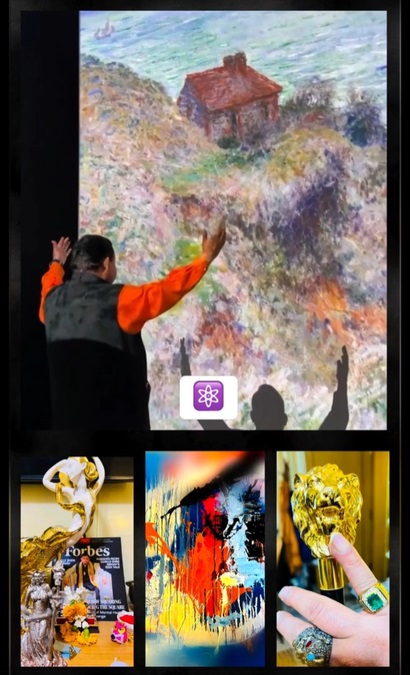
Abstract expressionism is an art movement that emerged in the 1940s and 1950s, characterized by gestural brush-strokes or mark-making, and the impression of spontaneity. It often emphasizes the physical act of painting itself as an essential aspect of the finished work. See video and pic to start your journey into impressionism but ONLY if you are ready.
In this painting, you can see vigorous, expressive paint application, a strong visual rhythm, and a dynamic interaction of colors and forms. The use of dripping and splashing paint also relates to techniques used by abstract expressionist painters. Due to its abstract nature, the painting does not clearly represent specific objects or scenery but instead seems to focus on conveying emotion or concept through the composition and application of paint.
The artwork's use of vibrant colors and bold, dripping, and splattered paint strokes might suggest a range of emotions. The fiery oranges and robust reds could be indicative of passion or intensity, while the chaotic application could represent an outpour of emotion, possibly a release of frustration, anger, or a search for liberation. The juxtaposition of these warm colors against the cooler blues and whites also adds to the dynamic tension within the piece, perhaps hinting at conflicting feelings or the complexity of the human psyche.
In the abstract painting shown, I can identify several colors, including shades of:
Blue
White
Black
Orange
Red
Pink
Violet
Legends and those in advanced studies in Gem Therapy should get themselves enthralled by identifying colours and patterns in the Ultra Violet Zone and the Infra Red Zone and see the magnificence of the Art and the Artist.
The Way of Life and Guruji- What do I see When I turn the painting Upside Down:
The orientation of a painting can significantly alter the viewer's perception of its content-try doing it yourself.
When a painting is turned upside down, the balance of forms and the flow of colors create a new visual dynamic. In this image, the upside-down orientation emphasizes the drips and splashes of paint, which now seem to defy gravity, moving upward and giving an impression of energetic movement. The bold contrasts between the dark and light areas, as well as the intense patches of orange, are striking and draw the eye in various directions. This also clearly communicates that inspired works and life conditions that have come to an abrupt halt and faced many years or months of delay can be catalyzed into action.
Abstract art often invites varied interpretations, and the inversion can sometimes reveal new shapes or patterns that were not as noticeable in the original position. It's interesting to consider how this change in perspective can shift the narrative or emotional impact of the artwork. Some viewers might find this rearrangement more harmonious or chaotic, depending on their personal response to the new visual arrangement.
The Past of the Past- If there was any such thing.
In a world where reality is stitched together with threads of magic and ancient mysteries, there lived a woman named Amara, a gifted painter from the heart of Brazil, whose life was as vibrant and tumultuous as the strokes on her canvases.
Her journey, marked by trials and tribulations, led her on a quest far beyond the borders of her homeland, to the spiritual landscapes of India.
Amara was no ordinary artist. Her paintings were rumored to hold the essence of the universe's deepest secrets, each brushstroke imbued with the power to heal and transform. This power, however, was not hers by chance.
It was inherited from a lineage of women who, through ages, guarded an ancient ritual involving healing gems—amethysts that glowed with an inner light, sapphires that whispered the wisdom of the oceans, and emeralds that could heal the deepest wounds of the spirit.
But with great power came great challenge. Amara's latest creation—a painting that seemed to capture the very soul of existence—was incomplete. A vital element was missing: the Sacred Key, a mystical symbol lost in the annals of time, believed to unlock the true potential of her gifts and reveal the ultimate purpose of her lineage.
Her search for the Sacred Key led her to the mystical lands of India, where the air buzzed with ancient mantras and the ground was soaked with the energies of sages past. Here, she encountered the Keepers of the Ancient Flame, a secretive sect that worshiped the fierce Goddess of Death-The Kali- that guided her through spiritual trials designed to test her resilience, wisdom, and the purity of her heart.
Each trial brought her closer to her inner self, peeling away layers of doubt and fear, and imbuing her spirit with the sacred light of understanding.
During a moonlit ritual by the Ganges, with the chants of the Keepers echoing into the night, Amara had a vision. The Sacred Key appeared to her not as an object, but as an enlightenment—a realization that the true power of her gift did not lie in the healing gems alone but in the unity of all elements: the earth of Brazil that molded her, the waters of the Ganges that purified her spirit, the fire of her trials, and the air that carried the ancient mantras the ancient spirits of her ancestors
With this revelation, Amara returned to her painting, her brushes dancing with newfound purpose. As she added the final stroke, the painting erupted in a kaleidoscope of light, each gem embedded in the canvas shining with the power of the elements. The Sacred Key had been within her all along, waiting to be discovered through her journey.
Amara's painting became a beacon of healing and wisdom, drawing souls from across the world to bask in its glow. The woman who once sought to finish a masterpiece had herself become a masterpiece of the universe's making, a conduit of ancient wisdom reborn in the canvas of the present.
And so, through her trials and tribulations, Amara uncovered the Sacred Key, realizing that the true essence of existence lay in the harmonious unity of life's diverse tapestry, bestowing upon the world a painting that was not just seen, but deeply felt, weaving together the spiritual destinies of Brazil and India for eternity.
The exploration into the present and the next life: The connect with the Maestros.
In the exploration of Amara's story through her evocative painting, we journey into a narrative that skillfully bridges personal expression with the echoes of established artistic traditions. Amara, an emerging artist with a distinctive voice, channels her experiences, emotions, and perceptions into her work, creating a vivid, immersive visual story.
Her painting, veiled in rich, intricate layers, not only unfolds her personal tale but also subtly mirrors the essence of some legendary artists. Let’s delve into how Amara's artwork resonates with the styles of these established artists while maintaining her unique essence.
Amara's painting is a testament to her personal journey, a canvas where light and shadow play in harmony, encapsulating moments of joy, sorrow, and revelation. The choice of colors, the brushwork, and the composition invite the viewer into a deeply personal space, yet it speaks a universal language. This marriage of the personal with the universal recalls the emotive intensity of Frida Kahlo's work, where each stroke is a glimpse into her soul, portraying pain, love, and resilience. Like Kahlo, Amara uses her art as a means of exploration and catharsis, offering a window into her inner world.
The structural dynamism and emotional depth in Amara's painting echo the revolutionary techniques of Vincent van Gogh. Van Gogh's ability to convey emotion through swirling stars, cypress trees, and sunflowers, transforming the ordinary into the sublime, finds a parallel in Amara's work. Her use of texture and movement imbues her painting with a life of its own, each brushstroke contributing to a sense of tumult and tranquility, reminiscent of Van Gogh's passionate and turbulent canvases.
Moreover, Amara's nuanced handling of light and shadow, and her ability to draw the viewer into the depth of her scenes, share affinities with the luminous quality of Johannes Vermeer's paintings. Vermeer's masterful manipulation of light to create intimate, serene, yet profoundly complex scenes is mirrored in Amara's work. Her painting, through its layers and contrasts, achieves a luminous quality that suggests the transient beauty of moments captured in time, inviting contemplation and emotional engagement.
Amara’s incorporation of abstract elements, bridging the tangible and the intangible, evokes comparisons to Wassily Kandinsky’s pioneering abstract work. Kandinsky's belief in the evocative power of forms, lines, and colors to express the soul's inner sounds finds an echo in Amara's painting. Her abstract elements do not merely fill space but speak a distinct language, inviting interpretations that transcend the visual, much like Kandinsky’s compositions that leap towards spiritual dimensions.
In crafting her narrative, Amara not only brings her story to life but also pays homage to these artistic giants, weaving a thread that connects her contemporary reflections with their timeless expressions. Her painting serves as a bridge between personal experience and universal themes, demonstrating how personal narratives can resonate with the broader strokes of human emotion and creativity. Through her art, Amara joins the ranks of those artists who see the canvas as a medium of personal exploration and a portal to the shared human experience, highlighting the enduring power of art to connect, communicate, and inspire.
Do Gems Work| Astrological Gem Impact| Celebrity Reviews| Gemstoneuniverse
What should this piece of Art Be Named:
I contemplate on several occasions as I glance and appreciate it off and on and here is what I came up with the Guruji Shrii Arnav 9:12 way.
You can do two things:
Suggest a title
Or
Make one from the list below from the divine orchestra of the 9 planets and the 12 houses. Cmon- Delight Me
1. "Resonance"
2. "Ebullient Chaos"
3. "Ignite the Spectrum"
4. "Abstract Reverie"
5. "Rhythm of Color"
6. "Fragmented Dreams"
7. "Chromatic Symphony"
8. "Urban Vibes"
9. "Energetic Whispers"
10. "Kaleidoscopic Journey"
11. "Dissolution"
12. "Vivid Serendipitous Echoes "
Best Gemstone Recommendation in India | Best Gemstone Astrologer | Guruji Shrii Arnav
The Power of Reflection
I have shared some of my thoughts of what happens when the painting is turned upside down.
BUT
Contemplate what happens when you see the painting in a MIRROR- Just the reflection.
I wish you well- You are an artist- I am NOT- definitely NOT.
Now,
Some Brilliant people and advanced students who want to work with me should access these two resources: click on links to view
Guruji Shrii Arnav and Gem Art:
https://youtu.be/tpjU1YNRSZ0?si=8AelHRWCKHput6ik
and
The 9 Stages of Love and Lovers | The Art of Love
https://www.gemstoneuniverse.com/the-9-stages-of-love-and...
And For the sake of Simplicity , allow me to reproduce the first paragraph of this post again: Hey- Here we go again:
At the very outset let me emphatically clarify that I have no knowledge of Art or Artists or Colors or Anything Else. This is my clear and categorical statement and if you beg to differ that’s your own opinion and Good Luck to you.
Anytime you get a question in any part of my thoughts listed below please come back to this first paragraph.
Also I have no idea about Gemstones, Light or gem Therapy.
And If you cannot Make : Heads or Tail out of this post- CONGRATULATIONS- You are an ARTIST- Well at least Better than Me.
PS: for Art Lovers- The high Res Painting is in my Stories Section today and I am not posting the inverted and reflection versions.
 Key To Symbols/Formulae
 Above
Above
 Search Guruji Shrii Arnav & The Power of 9

 12 Sacred Laws of Karma Meditation
9/12: Power of 108
 Squaring the Circle-Circling the Square
9/12- The Guruji Shrii Arnav way.
 MMBD- Madhu Makkhi Bitha Dijiye
 Namaste- I bow to your Soul
 One Light
 Standard Disclaimer Applies
 Search Guruji Shrii Arnav “ Search Term”
…… Fill in the blanks that makes you happy
 .. Fill My Bank.
-
From the desk of Revered & Beloved Guruji Shrii Arnav
Thank you, dear patrons & fans, - To keep us in your prayers & inspiring us to go beyond. You give us strength to follow our Motto –
“Deo Amabiles Et Hominibus” - Pleasing to God & to Men
May you be happy, healthy and protected! – Guruji Shrii Arnav
Connect with Gemstoneuniverse on Social Media via the links below:
Facebook:https://www.facebook.com/gemstoneuniverse
Instagram:https://www.instagram.com/gemstoneuniverse(@gemstoneuniverse)
Youtube:https://www.youtube.com/user/GemstoneuniverseIn
Follow Guruji Shrii Arnav’s public posts on Facebook:
https://www.facebook.com/emeraldriverindia

Spiritual Guru, Mystic, Mentor, Astrologer & Author. He is one of the leading experts & professionals in the field of gems and Gemology. He is also an Accredited Jewelry Professional from the GIA (Gemological Institute of America). He is the horoscope columnist and astrologer of the Deccan Herald-a Leading English Daily Published from India. He is widely credited with standardizing Gem Therapy & spreading the knowledge of Jyotish Gemstones at a larger scale.
He is the author of the internationally acclaimed book The Secrets of Jyotish Gems.
www.gemstoneuniverse.com is a leading online retailer of precious untreated Gemstones that have played a significant role in standardizing the online retail and e-commerce of Gemstones that are rare and highly-valued commodities
Gemstoneuniverse is the world’s leading authority on Astrological Gemstones and Jyotish Gemstones. To view a treasure chest of 3500+ articles written by Gem Professionals and Astro Gemologists please click here or visit the Gemstoneuniverse Blog.
What Kind of Problems can Gemstones & Astrology Solve? Can Gemstones help me achieve my Goal.
Which is the Best gemstone Choosing Method.
Tell me my Lucky Life changing Gemstone!
The Gemstoneuniverse Core Team
Related helpful Links
|
Is it possible to have no results from Gemstones/ Gem Therapy? |
||