


HOGSU — Inside the Truth of Gem Pricing, Risk & the Human Mind
From African Sapphire Rough to the Psychology of “Uncut Gems”
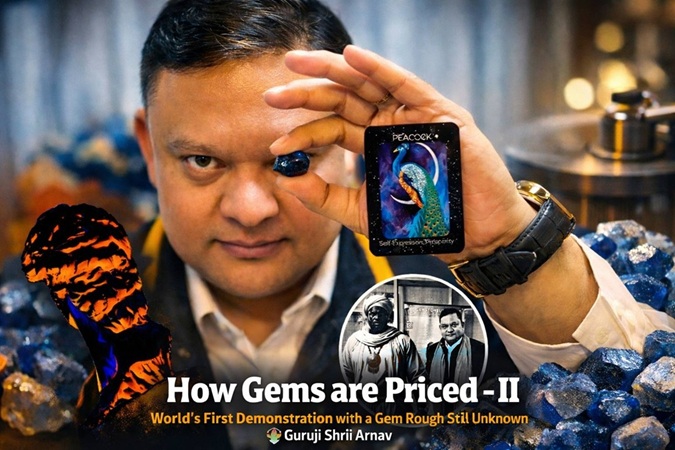
In the last few days, after global discussions around gold, interactions with the World Gold Council, and international media coverage, many new eyes are watching how we work — not just what we say.
That makes transparency not a marketing choice, but a responsibility.
Which is why this presentation is fundamentally different.
This is not a mock-up. This is not a classroom demonstration. This is real African sapphire rough, evaluated on camera, before it has ever entered the retail gemstone market.
Very rarely does an end customer get to see this stage of the gemstone journey — where promise, speculation, loss, and potential all exist in the same stone.
How Gems Are Priced – II | World’s First Real Demo with Sapphire Rough | Guruji Shrii Arnav-Legend
Reality Check #1 — Rough Is Not a Big Gem Waiting to Happen
One of the biggest misconceptions taught by search engines and even some gem schools is simple arithmetic: If a rough weighs 35 carats, you should get something close to that after cutting. That is dangerously incorrect.
In the demonstrated footage, the rough weighs approximately 7.07 grams — roughly 35 carats. But from a professional cutting perspective, if the objective is exceptional beauty, eye-clean quality, and no heat treatment, the most realistic outcome is one fine sapphire of about 7 to 8 carats.
Which means 75–80% of the material is lost in the pursuit of quality. This is not waste. This is the cost of excellence.
Reality Check #2 — Same Stone, Three Prices
Rough is segregated and priced differently based on yield probability and cutting feasibility:
- Whole premium rough: priced as a complete gamble
- Smaller clean fragments: priced higher per gram
- Host-material pieces: priced lower due to yield risk
Each category carries its own economics and buyer psychology. This is why gemstone pricing begins at the mine and changes hands multiple times before it reaches a client.
Gem business is not only geology. It is capital risk, timing, experience, and emotional discipline.
Where Gemology Meets Jyotish — Colour, Pleochroism & Planetary Suitability
What makes certain sapphires exceptional is not only hue, but pleochroism — the ability to display multiple colours from different crystal orientations. Blue–green pleochroism becomes especially significant in Jyotish contexts.
For individuals with specific Saturn–Mercury planetary combinations, blended frequencies can be more harmonious than pure monochromatic stones. This is where Jyotish Gem Therapy (GJT) becomes fundamentally different from commercial gemstone selection.
The question is not only whether the stone is large and attractive, but whether its frequency is appropriate for the individual nervous system, karma, and planetary rhythm.
The Hidden Player in All Pricing — The Human Mind
Gemstones themselves are neutral. They do not create greed, fear, or obsession. Humans do.
High-risk trading environments amplify impulses, ego, and short-term thinking. Many failures in gemstone and precious metal businesses occur not due to lack of intelligence, but due to inability to regulate desire under uncertainty.
Fast money excites. Quick wins intoxicate. But sustained success requires patience and discipline that are rarely glamorous.
Humans of Gemstone Universe — Recommended Watch
For those who wish to understand the psychology behind high-risk trade, the recommended viewing is the extended version of the film “Uncut Gems.”
This is not a film about gemstones. It is a film about decision-making under pressure — cash-flow stress, vendor politics, ego, and the illusion of being one win away from freedom.
The cinematography uses 35mm anamorphic lenses, intentionally compressing space and creating visual tension, making even calm scenes feel stressful. The camera itself feels anxious — mirroring the psychology of speculative business.
For Deeper Learning — Structured Knowledge Resources
Why Are Gemstones So Expensive? — Price Per Carat Explained
https://www.gemstoneuniverse.com/gemspricepercarat.html
How to Know the Correct Price of a Gemstone (Trade Floor Video)
Inside Bangkok Gem & Jewelry Show — Live Walkthrough
How to Choose a Gemstone in Astrology — Monastery Session
Colour & Planetary Power in Jyotish Gemstones
https://www.gemstoneuniverse.com/jyotish-gemstones-color-shades.html
Closing Thought
Whether one deals in gemstones, gold, business, or life decisions, the lesson remains the same: learn to respect uncertainty, slow down desire, and price not only objects, but outcomes.
Because in every trade, the most valuable asset is not what is on the table — but the clarity of the mind making the decision.
— Guruji Shrii Arnav
Humans of Gemstone Universe